What the Feed Stopped Sending
A story. Larkspur Benefits, the people in it and every number here are invented, but the operation is real.
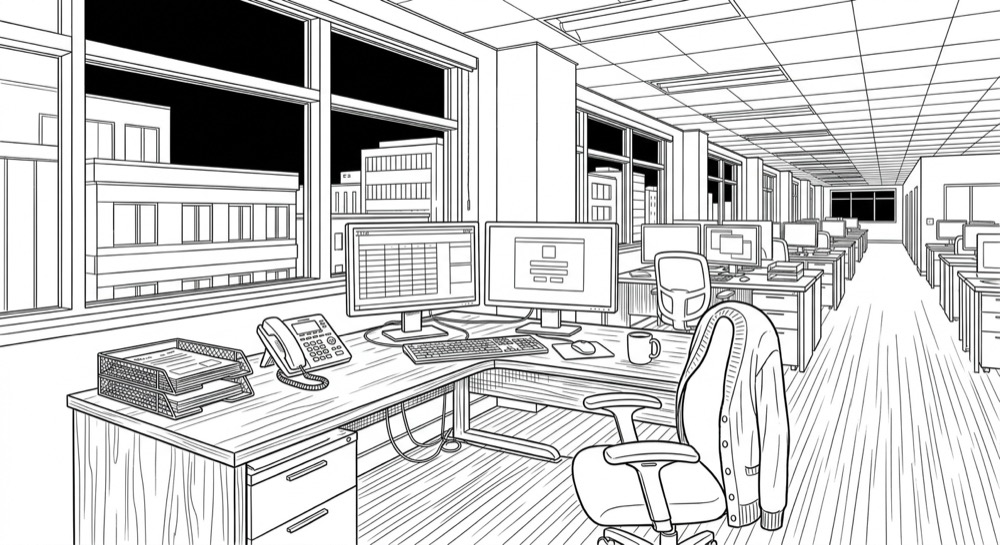
Every Friday at half past five, after the office had mostly cleared out, a benefits coordinator named Marisol Vega opened the carrier's enrollment portal in one window and Larkspur's internal system in another, and typed the week's changes from one into the other by hand. New hires, dependents added at marriage, a plan tier changed after an employee's second child, terminations. She'd been doing it for fourteen months, ever since the automated feed between the two systems had quietly stopped carrying real data and started carrying nothing, successfully, every night, which is a different failure than the feed going down and a much better one at hiding. Nobody above her had ever asked why the Friday numbers always matched, and they matched because Marisol made them match.
Teddy Voss called in January, the week after open enrollment closed, because a machine operator at Anderlee Manufacturing had shown up at a pharmacy with his daughter's asthma prescription and been told he had no coverage, and by the time anyone at Larkspur understood why, four more calls like it had come in from the same plant. Anderlee was Larkspur's largest client, twenty-two hundred lives, and Teddy had built his company for six years on the belief that operations was a made-up department for businesses that couldn't hire well enough to avoid needing one. He told Jay this almost immediately, in the first ten minutes, unprompted, the way a person states a thing they have said so many times it has stopped being an opinion to them.
"I need someone to run the renewal season next year so this never happens twice," he said. "A project manager. Somebody to keep everybody on schedule."
"You already have four people keeping everybody on schedule," Jay said. "What you need to know is why none of them noticed the schedule was wrong."
Teddy's office had a view of the parking structure rather than the mountains, which he had once explained to a reporter as a deliberate choice, so that nobody on his team would spend a Tuesday looking at something they couldn't sell. He skipped that explanation with Jay and offered a spreadsheet, twenty tabs, one per department, and said the answer was in there somewhere if Jay wanted to look for it.
Jay didn't open the spreadsheet until Wednesday. For the first two days he sat with a laptop at an empty desk near enrollment and simply watched the work go by. He watched Marisol's Friday ritual on the first evening, by accident, having stayed later than he meant to, and asked her about it the next morning before she could decide whether to mention it herself.
"It's not really a big deal," she said. "The feed's been flaky. I just double-check it."
"How flaky."
"I mean, it stopped a while back. I just do it manually now."
"How long is a while back."
She had to think, which told him more than the answer did. Fourteen months, since a routine update on the carrier's side, after which the sync had continued running on schedule, logging success, and moving zero records, because nobody had ever built it to check that the records it moved were the records that existed. Larkspur's vendor had a support ticket open for six days the previous spring, after a different, smaller client noticed a discrepancy, and had closed it as resolved without anyone confirming the fix against real data, because confirming it was not the kind of work anyone got measured on.
Down in claims, a coordinator named Dennis Okafor had built his own version of the same fix, independently, without telling anyone, because he had noticed the same drift from the other direction: claims coming back denied for coverage that should have existed. He kept a manual override log, a shared spreadsheet only he used, cross-checking denials against a paper binder of enrollment changes he printed himself every month in case the system version disagreed with reality. Eleven months he'd been at it, with no idea that Marisol was doing the parallel version two rows over.
"Does anyone else know you do this," Jay asked him.
"Do what. My job?"
Between the two of them, Jay counted roughly thirty hours a week of invisible manual correction, absorbed personally, that had kept the failure from ever reaching a size anyone above them would notice, until December, when it reached that size only because Anderlee's renewal happened to land in the one week Marisol took vacation in four years, and Dennis had been out with the flu the same week, and the feed, unwatched for the first time since it broke, had sent Anderlee's actual enrollment file to the carrier exactly as broken as it had been the whole time.
Teddy convened his four department heads on Thursday. Colby Marsh, who ran sales, said the renewal timeline was too aggressive and always had been. Renata Cho from client services blamed the carrier's portal, which changed without warning and always would. And Farrah Delgado, who owned systems, pointed out that the vendor had certified the integration and Larkspur had paid for that certification specifically so this couldn't happen. Jay put a single page on the table, one enrollment change from a member's life event to the carrier's confirmation, and on it, in a box by itself, fourteen months during which the only thing keeping that path honest was two people nobody had promoted staying late on Fridays.
"Every one of you is right about your part," Jay said. "Nobody in this building owns whether the parts still add up to a company that pays claims correctly."
Farrah pulled the vendor's six-day ticket that afternoon and read it twice before she said anything. "They closed this as resolved. Nobody ever verified it against a real file." She looked like a person doing arithmetic she would rather not finish. "I approved the renewal on that certification."
Jay woke at three that morning in a hotel off Speer Boulevard with his heart going, having dreamed again about a distribution company outside Cleveland where he had stayed nineteen months, wanted enough by the end that leaving felt like an injury to people who had never once been asked to learn how to run the thing without him. He'd spent two years afterward coming to understand that being needed and being useful are not the same feeling from the inside, and that he had let the first one stand in for the second because nobody had told him to check.
He sat with the laptop open and cut the proposal he had drafted on the flight, an eighteen-month platform rebuild that Teddy, scared enough after Anderlee, would have signed without reading past the number. He wrote a shorter note instead: a company that had run fourteen months on two people's unpaid vigilance was not a company that could yet tell him what to build, and an eighteen-month contract would mean Jay deciding that for them by default, on Teddy's money, at Teddy's risk.
What he built in the eleven days that followed was smaller and less impressive on paper. The first piece was an agent watching the nightly sync, checking past whether it had run to whether the record count it moved matched the record count that existed on both sides, and alerting a real person within the hour if the two ever disagreed again. Out of Marisol's sent mail and Dennis's override log he pieced together fourteen months of corrections nobody had ever written down anywhere durable, and turned them into a single owned record of what the company actually knew about its own enrollment data. The last piece was a new role, Operations Coordinator, that had never existed at Larkspur because Teddy had never believed in it, with a job description built entirely out of the parts of Marisol's and Dennis's jobs that had never had a title.
"So the answer to my question was a job posting," Teddy said, reading it.
"The answer to your question was that you've been running a company-sized operation on two people's overtime and calling it culture. The posting is what happens once you stop."
The heartbeat caught its first real disagreement on day nine, a Tuesday, three minutes after the nightly sync ran, over a batch of eleven dependent additions that the carrier's system had silently rejected for a formatting reason nobody at Larkspur had encountered before. Farrah got the alert on her phone at ten past midnight and fixed it before nine the next morning, and no client ever knew there had been anything to fix. She sent Jay a screenshot of the alert with nothing written above it, the way people do when the thing speaks for itself.
He left on a Friday, the eleventh day, without a send-off, because Teddy did not do those and Jay did not ask for one. Marisol caught him at the elevator with her coat already on.
"I got the posting," she said. "I'm putting in for it."
"You should. You've been doing it for over a year for a title that didn't exist."
"I know." She was quiet for a second. "Dennis isn't, though. Putting in for it."
Dennis Okafor gave notice three weeks later, to a competitor two miles down the interstate, at a modest raise that Jay suspected was not really the reason. He had spent eleven months catching a company's worst failure with a binder he printed himself, and the company's response, once it finally noticed, had been to build a role for the version of that work that ran through enrollment, while his had run through claims. Nobody had done anything to him. Nobody had done anything for him either, for eleven months, and by the time Larkspur understood what he had been worth, the offer was already in his inbox.
Marisol got the role in March. Teddy sent a company-wide message calling it a new investment in operational excellence, and did not mention that the excellence had been running, uninvested in and unacknowledged, since the previous January.
The renewal season the following December closed nine days ahead of schedule, on data both sides had actually checked, and nobody at Anderlee Manufacturing ever learned how close the year before had come to costing a machine operator's daughter her prescription. Jay heard about the smooth renewal secondhand, from Farrah, who still sent him a screenshot every time the heartbeat caught something small before it became a story.
His phone went off again on the drive to the airport, another founder, another company, four lines about a system nobody had audited in years, phrased with the specific confidence of a person who does not yet know what the words in his own sentence mean.
They never do, at the start, and that's usually why they call.
Jay Burgess is an operational systems leader who works through forward deployed engineering, data science and analytics, and systems thinking. He lives in Los Angeles.