The Forward Deployed Engineer
A delivery discipline that starts at the operating problem and stays until the outcome holds.
The gap the role exists to fill
Two established roles sit on either side of a gap. A consultant answers for a recommendation and a product engineer answers for shipped capability, and neither one answers for whether the operation actually changes.
I've watched good work disappear into that gap from both sides. Sometimes the recommendation is sound and never lands, because nobody owned the part where an organization has to do something differently. Other times the capability ships, works, gets adopted, and nobody's working day is any different. The deck was right, the code runs, and the operation behaves exactly as it did before, like a relay where both runners are fast and the baton still ends up on the track. Someone has to own the distance between a working system and a changed operation.
The gap comes from how both professions are structured, which is why it turns up in engagement after engagement. Consulting is priced and staffed around an analysis phase, and the incentive is to reach a defensible recommendation efficiently and move the team on to the next client. Product engineering is organized around a roadmap and a definition of done that ends at release, because a team that stays inside one customer's operation is a team that isn't building for everyone else. Both structures are rational, and neither has anyone in it whose work stays unfinished while the operation is unchanged.
For that person, the unit of delivery is the outcome, and the accountability sits inside the operation itself, with nobody reporting on it from a delivery organization outside. Each of those is an argument in its own right, and I've made them elsewhere.
Why the outcome is the unit of delivery
Proximity is the method
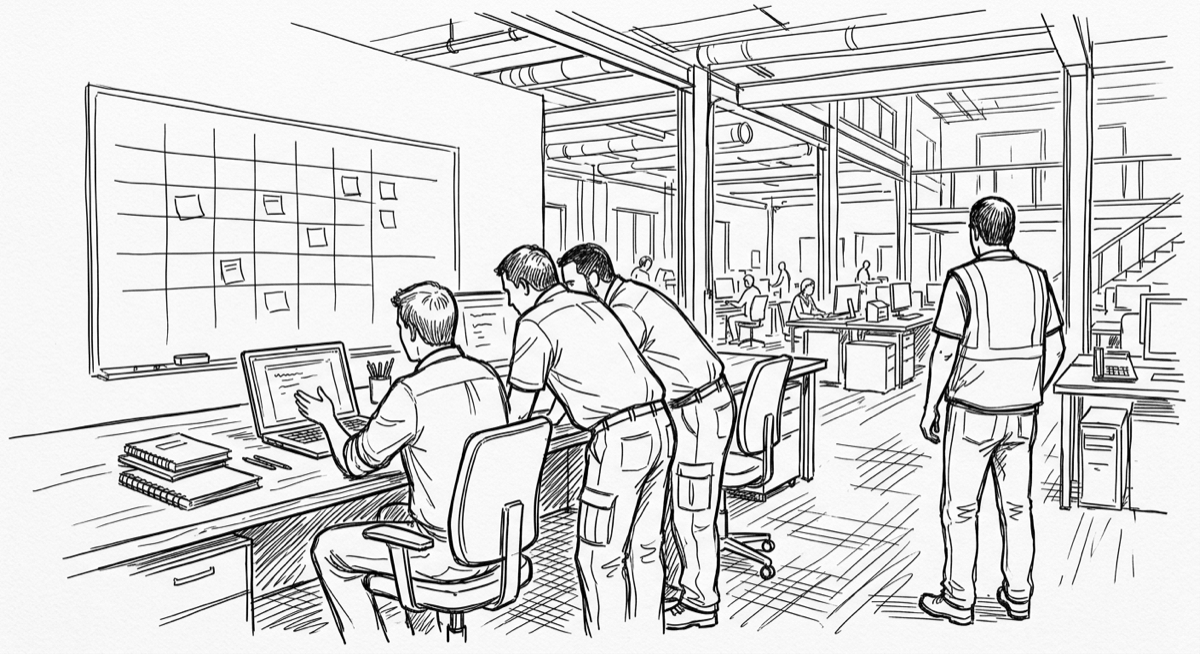
An operation can't be specified from a conference room. Work as performed and work as documented are different systems, and the distance between them is the real brief. The spreadsheet kept beside the platform, the approval that happens by message before it happens in the tool, the step everyone skips because it stopped mattering years ago: that's the specification, and it isn't written down anywhere, nor will it come up in a requirements session, because the people doing it no longer notice they're doing it.
People in requirements sessions are usually being as helpful as they can, and the trouble lies in what that kind of session can physically recover. Asked to describe their work, people give you the version they'd give a new starter: the intended path, cleaned of the detours that have become automatic, the way someone giving directions forgets the pothole they swerve around every morning. The detours are the load-bearing part, and better questions in the same room won't reach them. What reaches them is being present when the work happens and noticing the thing the person didn't narrate, because it never occurred to them that it counted.
Proximity also changes what you're allowed to hear. The first week produces the official account. Somewhere after that, once it's clear you aren't scoring anyone, people start telling you which approver is slow, which report nobody reads, which field everybody fills with a placeholder. None of that is available to a visitor, and all of it is the actual system.
In this discipline proximity does the work of an instrument, the way a stethoscope does for a doctor, and filing it under soft skills misses what it's for. You're close to the work because that's the only place the information exists.
The loop
The loop goes like this: observe the work as performed, find the constraint, and design the smallest system that relieves it. Build against real cases, deploy into live conditions and measure what happens, then run the whole thing again with whatever production just taught you.
Two of those steps carry most of the weight, and they're the ones most often softened. Smallest is meant literally: the smaller the intervention, the faster the loop closes and the more clearly the result can be traced to the change. A large first build produces an ambiguous result six months late. Real cases matter because representative cases are selected, usually by someone trying to help, and the selection quietly removes exactly the awkward instances that decide whether the design survives. Ask for the last forty cases that came through, whatever they look like.
Each pass narrows the problem. The first pass is usually wrong about the constraint, and that's the loop doing its job, much as a first draft exists to show you what the second one should say. An organization that can only afford one pass is buying a guess and calling it a plan.
Being wrong on the first pass has to be affordable, and that gets settled in the commercial structure of the engagement, well before method comes into it. If the engagement is priced so that a revised understanding reads as failure, nobody will revise. The loop only runs in an arrangement where changing your mind about the constraint in week six is expected, and nobody has to negotiate it as a variation.
What the deployment step does to the problem
What the role is not
The role is easy to confuse with its neighbors, and walking past each of them is the quickest way to see its shape. Consulting with an editor open comes closest on paper, though a consultant can be right and leave, and this role only ends once being right has changed the operation.
Pre-sales solution engineering ends at the signature, which is roughly where this work begins.
Customer success sits nearby too, and there adoption tends to be the goal. Here it's only a measure, because a well adopted system sitting inside a broken arrangement just moves the same loss along more efficiently.
A contractor who leaves at go live walks out at the very moment the useful information starts arriving.
The closest relative is an internal transformation team. Internal teams have the proximity and usually lack the standing: they inherit the organization's existing politics, they can't easily say that a senior person's process is the constraint, and their scope tends to be assigned before anything is discovered. The forward deployed position is useful partly because it sits slightly outside, which buys the freedom to name things a colleague couldn't name without paying for it.
If you're the only person who understands the system, what you're holding is a defect report.
Leaving well
The exit condition is ownership, not launch. The work is complete when the organization no longer needs the person who built the system to operate it, understand it or alter it. If removing that person would degrade the operation, the work isn't finished, however good the system looks.
Ownership has a testable form. There's a named person inside the organization who can explain why the system works the way it does, which goes a layer deeper than knowing how to use it. Someone has changed it without the original builder present, and the change held. When it broke, the organization diagnosed the break itself. Until those three things have actually happened, the handover is still a document and the transfer hasn't taken place.
Most delivery models get this wrong in the same direction, optimizing for the handover document and treating the dependency as somebody else's problem. A system that only its author can maintain is a liability with a nice interface.
The failure has an emotional side that's worth admitting. Being needed is pleasant, and a builder who is still the only person who understands the system gets a steady supply of evidence of their own value, a bit like the one person in the office who knows how to unjam the printer. The discipline is to read that evidence as a defect report.
Why it should be a discipline
At the moment the title is mostly a description that a handful of companies apply to a handful of people, and it means something slightly different at each of them, which is a weak position for work this consequential.
The work already has what a discipline needs: a method in the loop, a unit of delivery in the outcome, and an exit condition in operational ownership. Those three things can be taught and they can be assessed. What's missing is a shared vocabulary and a standard of practice, and both get built by people writing down what they actually do.
The absence has practical costs. Organizations can't hire for the role reliably, because there's no agreed description of what good looks like, and interviews fall back on testing either engineering or consulting, which selects for half the job. People doing the work have no way to show seniority in it, so they get promoted out of it into managing something else. And the failures aren't shared, which means each practitioner rediscovers the same four mistakes at their own expense.
Writing it down here is my contribution to that vocabulary.
If this describes an operation you’re responsible for, the diagnostic is where that conversation starts.
How engagements begin