Finding It Is Not Fixing It
Most organizations pay one function to find the problem and a different function to build the fix, and the distance between those two jobs is where the fix quietly goes missing.

The gap has an address
In most organizations, operations finds the problem and writes it up, and the write-up becomes a ticket. Technology receives the ticket, ranks it against a backlog of other tickets, and eventually delivers something adjacent to what was actually needed: close enough to close the ticket, not close enough to close the gap. Nobody involved did anything wrong, each person did their job inside the boundary they were given.
That boundary is the interesting part. Diagnosis and delivery get treated as two different disciplines because, in most of the work most of the time, they are, and specialization usually pays for itself. The cost shows up only at the handoff, in the translation between the person who watched the work fail and the person who didn't, and it never appears on anyone's dashboard, because no dashboard is built to measure a gap between two functions that each report success on their own terms.
Put the two paths next to each other and you'll see the handoff path run slower, for reasons that have little to do with lazy people or old systems. At every step, information has to survive being re-explained by someone who wasn't there to someone who wasn't there either, a bit like a message passed down a row of people at a dinner table, until what ships is a plausible interpretation of the original finding, which is a slightly different thing from the finding itself.
Two blind spots, not one
The operations side sees where the work actually breaks. Somebody skips a field, a report nobody reads gets produced anyway, an exception gets handled from memory because nobody built a place for it. That knowledge is real and usually accurate, though it's rarely written in a form precise enough for someone else to build against, because noticing was the job the person holding it was given, and specifying never came up.
The technical side can build precisely to a specification, but it can't see past the one it was given, because it wasn't in the room when that specification was drawn, and a specification inherits the blind spots of whoever wrote it. A well-built system against the wrong constraint turns out to be a more expensive failure than a poorly built system against the right one, because it shipped.
Split the two jobs and you've made a quiet bet that the handoff between them is lossless, and it rarely is. The loss compounds without anyone raising an alarm, because each side can point to work done correctly on its own side of the line.
A structure that closes it
Finance and HR solved a version of this problem decades ago with the embedded business partner, moving financial and people judgment out of a single office far from the work and into each department, where a partner sits close enough to see the actual decisions being made and to catch a problem while it's still small. Operations rarely gets the same structure, and usually ends up with either a central office that reviews and reports after the fact or individual analysts embedded without any shared method connecting what they find.
Applied to operations, the same structure puts a partner inside each department to observe, diagnose and manage execution as it happens, long before a quarter closes. That partner reports on two lines: day-to-day to the department head, because standing inside a team requires actually being accountable to it, and on method, findings, and escalation to a central function, because without that second line every department invents its own definition of a problem and nothing is comparable across the organization.
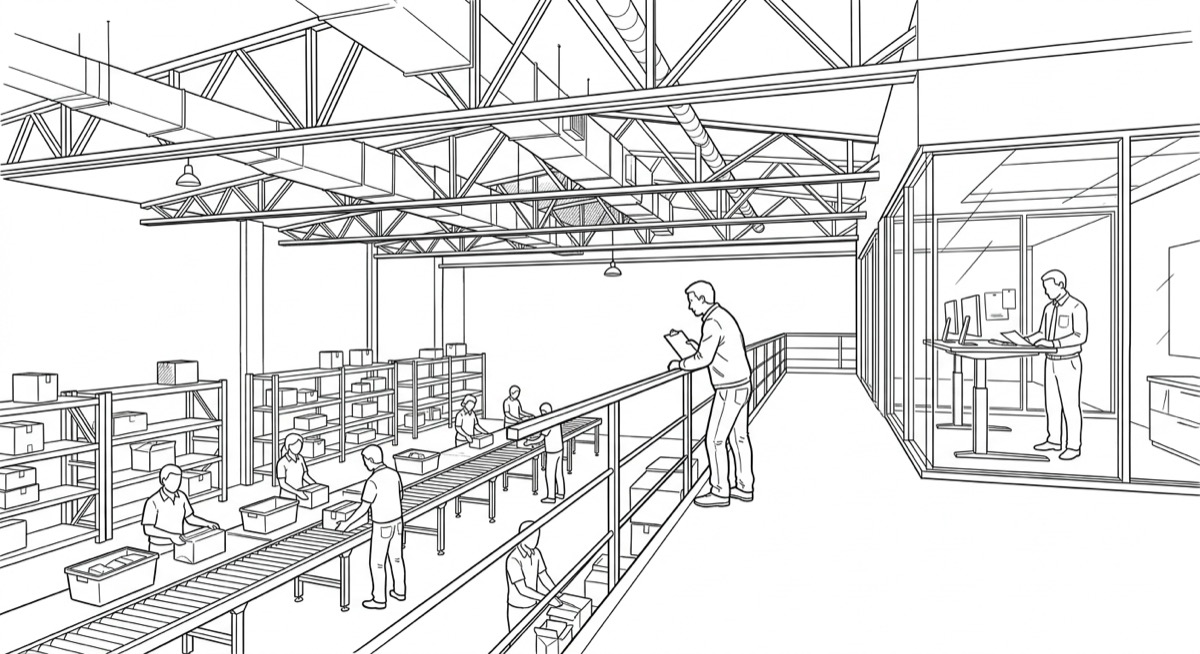
What gets centralized is deliberately narrow: the diagnostic method, the scorecard and the career path. Day-to-day decisions stay with the department that owns the outcome, and that narrowness is what keeps the model from turning into a shadow bureaucracy sitting on top of the one that already exists. The organization gets to see its own operating problems while they're still cheap to fix. Most organizations find them in a quarterly review, after the cost has already been paid.
What it produces, measured
Where this structure has run, the pattern shows up in the numbers, which are a sturdier place to find it than any story about culture. A misaligned tracking workflow was replaced outright, when the easier move would have been to staff around it, and that cut reporting cycle time by 40 percent and raised processing capacity by 25 percent with no increase in headcount. In a reporting function managing roughly six billion dollars in spend, executive turnaround fell by 86 percent once the reporting infrastructure itself was rebuilt, with the same people running it. And a workflow constraint that earlier reviews had missed entirely, because every earlier review had read about the work and none had watched it happen, was worth a 37 percent improvement in completion once the same effort found it and closed it.
Those numbers share a source. In each case a different question got asked, because the person asking it was also the person who'd have to answer for the build.
The seam still needs an owner
Diagnosis and delivery don't always have to sit with one person or one team, and plenty of work is genuinely too large, too specialized or too regulated for that. The claim here is narrower. Wherever the two are split, somebody has to own the translation across that seam, faithfully, and that job usually goes unowned by design, because a seam has no natural budget line and no natural manager standing on either side of it claiming it.
Another meeting between the two sides rarely changes much. What helps is a deliberate decision about which seams are expensive enough to close locally, by building the capability to diagnose and deliver in the same place, and which are cheap enough to leave split because the translation actually holds. Most organizations have never asked the question, they inherited the split the way they inherited everything else, one reasonable local decision at a time, until it was simply how the org chart looked.
If your organization routes diagnosis and delivery through different teams and the loss is invisible until a quarter ends, that seam is diagnosable.
How engagements begin